How to Manage 10+ Restaurant Outlets Without Being Physically Present
Scaling from one restaurant to ten changes your role completely.
At one outlet, control is intuitive.
You walk the floor.
You taste the food.
You check the inventory room.
You talk to the chef.
You spot problems immediately.
At ten outlets, that disappears.
You cannot be everywhere.
You depend on managers.
You depend on reports.
You depend on summaries.
You depend on trust.
And that is where performance drift begins.
Managing 10+ restaurant outlets without being physically present is not about delegation.
It is about structured control.
Without centralized visibility, multi location restaurant management becomes reactive.
With real time intelligence, it becomes scalable.
This article breaks down:
• Why control weakens after 5+ outlets
• The structural risks of remote restaurant oversight
• The systems high performing chains use
• The financial impact of decentralized management
• And how real time restaurant analytics restores operational confidence
If you operate or plan to operate 10+ outlets, this is no longer optional.
It is foundational.
The Shift From Operator to System Leader
When you run one outlet, you are the operator.
When you run ten, you must become the architect.
Your job is no longer daily supervision.
Your job is designing a system that maintains standards without your physical presence.
That system must answer five questions daily:
- Is food cost under control across all outlets
- Is inventory moving efficiently
- Are vendors aligned on pricing
- Are recipes executed consistently
- Are margins stable location by location
If you cannot answer these instantly, you are managing blind.
Why Control Breaks After 5 to 7 Outlets
Most restaurant chains experience their first structural cracks between 5 and 7 outlets.
Why
Because complexity multiplies faster than visibility.
You now manage:
• Multiple general managers
• Multiple vendor relationships
• Central kitchen transfers
• Outlet specific demand fluctuations
• Staff turnover cycles
Manual reporting systems cannot keep up.
Excel becomes heavy.
Updates become inconsistent.
Weekly meetings become reactive.
Small inconsistencies start compounding.
The 7 Operational Risks of Managing 10+ Outlets Remotely
Let us break down the real problems.
1. Food Cost Variance Across Locations
Outlet A reports 29 percent food cost.
Outlet B reports 34 percent.
Outlet C reports 31 percent.
Why the difference
Portion size variation.
Inventory miscounts.
Vendor pricing differences.
Waste handling inconsistencies.
Without centralized comparison dashboards, these gaps persist.
A 3 percent food cost variance across 12 outlets with 6 million dollars procurement equals 180000 dollars annually.
Small daily differences.
Large annual impact.
2. Inventory Blind Spots
Inventory inefficiency is rarely visible in revenue reports.
But it affects cash flow.
When outlets order independently:
• Safety buffers increase
• Dead stock accumulates
• Expiry risk rises
If your chain spends 5 million dollars annually on procurement and inventory inefficiency is 6 percent, that equals 300000 dollars in capital inefficiency.
Remote management without live inventory dashboards increases this risk.
3. Shrinkage Amplification
Shrinkage is harder to detect remotely.
When you are not physically present, reconciliation relies on reporting.
Even 2 percent shrinkage on 5 million dollars equals 100000 dollars annually.
Across 12 outlets, small discrepancies compound rapidly.
Without daily variance tracking, this becomes normalized.
4. Vendor Price Drift
Vendors rarely increase prices dramatically.
They increase gradually.
Across multiple outlets, inconsistent vendor pricing creates margin distortion.
Without centralized procurement analytics, you lose negotiation leverage.
A 3 percent procurement inefficiency on 5 million dollars equals 150000 dollars annually.
5. Recipe Execution Drift
Standard recipes define cost expectations.
But execution varies by chef experience, shift discipline and training quality.
A 5 gram over portion on a high volume item across 10 outlets may cost over 120000 dollars annually in high turnover models.
Remote oversight requires automated variance alerts.
Not trust based assumptions.
6. Manager Narrative Dependence
Remote oversight often becomes report driven.
Managers send summaries.
Area managers filter information.
Problems are softened.
Without centralized raw data access, leadership depends on interpretation.
Interpretation is not control.
7. Delayed Decision Cycles
Weekly reviews.
Monthly audits.
Quarterly reconciliations.
By the time leadership reacts, leakage has already compounded.
Managing remotely requires daily visibility.
Not monthly hindsight.
The Financial Model What Remote Mismanagement Really Costs
Let us model a 12 outlet restaurant chain.
Annual procurement 5 million dollars.
Conservative variance estimates:
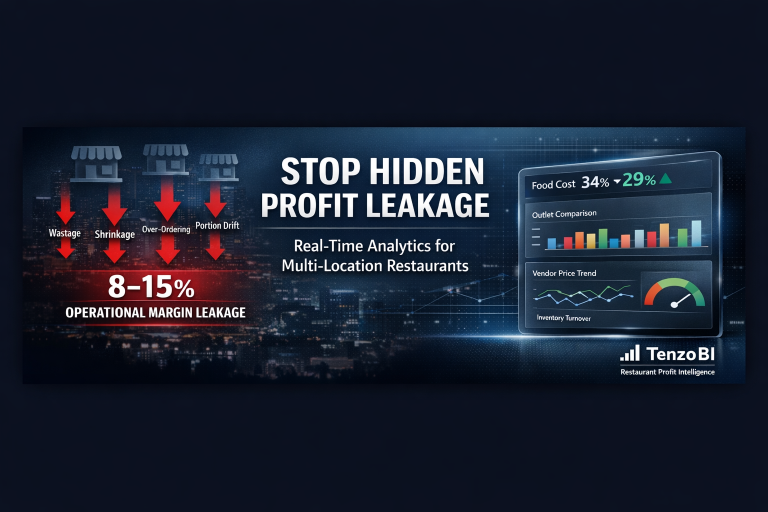
Food wastage 4 percent
Shrinkage 2 percent
Over ordering inefficiency 3 percent
Portion drift 2 percent
Total operational variance 11 percent.
11 percent of 5 million dollars equals 550000 dollars annually.
That is not a sales problem.
It is a systems problem.
Managing 10+ outlets without structured visibility costs real money.
The 5 Pillars of Managing Multiple Restaurant Outlets Remotely
Pillar 1 Centralized Real Time Dashboards
You must see:
• Outlet wise food cost daily
• SKU level variance
• Inventory levels
• Vendor pricing trends
• Contribution margin per branch
Without waiting for manual consolidation.
Central dashboards eliminate narrative distortion.
They surface raw performance metrics instantly.
Pillar 2 Exception Based Management
You cannot monitor everything manually.
You must monitor anomalies.
Real time restaurant analytics software should alert when:
• Food cost exceeds threshold
• Inventory consumption deviates
• Vendor prices spike
• Dead stock accumulates
You focus on exceptions.
Not routine operations.
This is scalable oversight.
Pillar 3 SKU Level Intelligence
Total food cost percentage hides detail.
SKU level tracking reveals:
• High loss items
• Underperforming menu items
• Portion variance patterns
• Demand misalignment
Managing 10+ outlets requires granular visibility.
Not summary level comfort.
Pillar 4 Central Procurement Control
Fragmented procurement weakens margin control.
Central visibility ensures:
• Standardized pricing
• Volume negotiation leverage
• Reduced vendor manipulation
• Regional price consistency
Centralized procurement oversight protects margin across all outlets.
Pillar 5 Structured Daily KPI Discipline
Remote management works only if daily KPIs are structured.
Critical KPIs include:
• Food cost percentage
• Waste percentage
• Inventory turnover
• Outlet contribution margin
• Vendor price variance
When leadership reviews data daily, operational discipline improves organically.
What High Performing Chains Do Differently
High performing restaurant chains do not rely on manual systems.
They invest in restaurant operations software built for multi location management.
They operate with:
• Live inventory dashboards
• Centralized food cost analytics
• SKU level variance tracking
• Vendor price monitoring
• Automated anomaly detection
They do not wait for problems to surface.
They prevent them.
Leadership Psychology From Supervision to Intelligence
When you try to manage 10+ outlets physically, you exhaust yourself.
When you try to manage them manually, you lose clarity.
When you manage through structured intelligence, you gain leverage.
Data reduces emotional management.
It replaces assumptions with evidence.
Remote control becomes strategic instead of reactive.
Frequently Asked Questions
Can you successfully manage 10+ restaurant outlets without being physically present
Yes but only with centralized data visibility, real time inventory tracking and structured KPI monitoring.
What is the biggest challenge in multi location restaurant management
Loss of standardized control across inventory, procurement and recipe execution.
How do large restaurant chains maintain consistency
Through centralized analytics dashboards, vendor control systems and automated performance alerts.
What software helps manage multiple restaurant outlets
Purpose built restaurant analytics and multi location management systems that track inventory, food cost and procurement centrally.
How TenzoBI Enables Remote Multi Location Control
TenzoBI is built specifically for restaurant chains managing multiple outlets.
It provides:
• Real time inventory visibility
• Centralized food cost tracking
• SKU level margin analytics
• Vendor performance monitoring
• Outlet comparison dashboards
• Automated exception alerts
Instead of calling managers for updates, leadership reviews live operational intelligence.
Instead of reacting monthly, teams correct daily.
TenzoBI transforms multi location restaurant management from supervision based to intelligence driven.
It allows founders, CFOs and operations leaders to manage 10+ outlets confidently without being physically present.
Because visibility replaces proximity.
And intelligence replaces assumption.
Final Thought
Scaling from 3 outlets to 10+ is not just operational growth.
It is structural transformation.
Without centralized visibility, growth amplifies inefficiency.
With structured intelligence, growth becomes profitable.
If you manage 10+ restaurant outlets and experience:
• Food cost inconsistencies
• Inventory inefficiency
• Vendor price drift
• Reporting delays
• Margin uncertainty
The problem may not be people.
It may be systems.
Request a TenzoBI Demo
If you want to see how your restaurant chain can:
• Improve operational control
• Reduce food cost
• Strengthen procurement discipline
• Maintain consistency across locations
• And manage remotely with confidence
Request a TenzoBI demo.
Get a structured operational assessment.
See how real time restaurant analytics can help you manage 10+ outlets efficiently, intelligently and profitably.
Because in multi location restaurant management, control should not depend on physical presence.
It should depend on structured intelligence.